

Visitors' Books
We Had Such a Lovely Time

Let’s open on the glory of a lovely blank page in a lovely expensive new visitors’ book.
The conceptual artist, Ulises Carrión told us:
“The most beautiful and perfect book in the world is a book with only blank pages, in the same way that the most complete language is that which lies beyond all that the words of a man can say.”
Well, maybe Ulises … but not with visitor’s books. (May I take a moment here to commend this article in Aeon by Andrew Gallix - which traces blank pages in literature that I found when looking for the Carrión quote - and which I ended up getting distracted by for a solid hour - thanks Andrew! He has a Substack too! Ulises Carrion seemingly does not1).
For one of the great pleasures, of course, is going to a house and flicking through their visitors’ (visitor’s? visitors’? Nobody knows) book and seeing who came before you.
‘Aha’, thinks the lucky guest (looking around at the vast pleasure grounds, the stately dining room, the well-stocked bar), ‘you might have enjoyed all this then but your time is up - now I am here. Enjoy wherever you are now’.
Similar sentiments can be felt in cemeteries.
Oh dear …
The punctuation thing has actually worried me. Sufficiently that I am going to do the very Sixth Form essay thing2 of looking at the OED. Having travelled there, just look at their definition:

Well, there it is folks - can’t you feel the raised eyebrows, the twitching nostrils of the big nobs over at OED HQ.
It’s that “and, sometimes, comments”. “Sometimes” …
I think it’s the putting of “sometimes” between two commas … they know what they’re about, those professional word-wranglers over at OEDHQ. You can hear them gasping with horror on each comma. The lorgnette wobbling with the sheer vulgarity (vulgarity: noun, first used 1570) of it.
The people, OED people seem to be saying, who put comments probably ought not to be reading this dictionary. Perhaps they’d be happier with a Collins Pocket edition.
For that’s the problem isn’t it? I remember going to a friend’s castle in Scotland with a group of friends in my teenage days - we were all queuing up ready to write something in their enormous and very grand visitor’s book. Whilst I was waiting to go, the chatelaine peered over someone a few ahead in the line and said, in her chummiest tone, said “oh how nice that you’re putting in comments” and it was clear to all of us that she meant “oh how REPULSIVE ”.
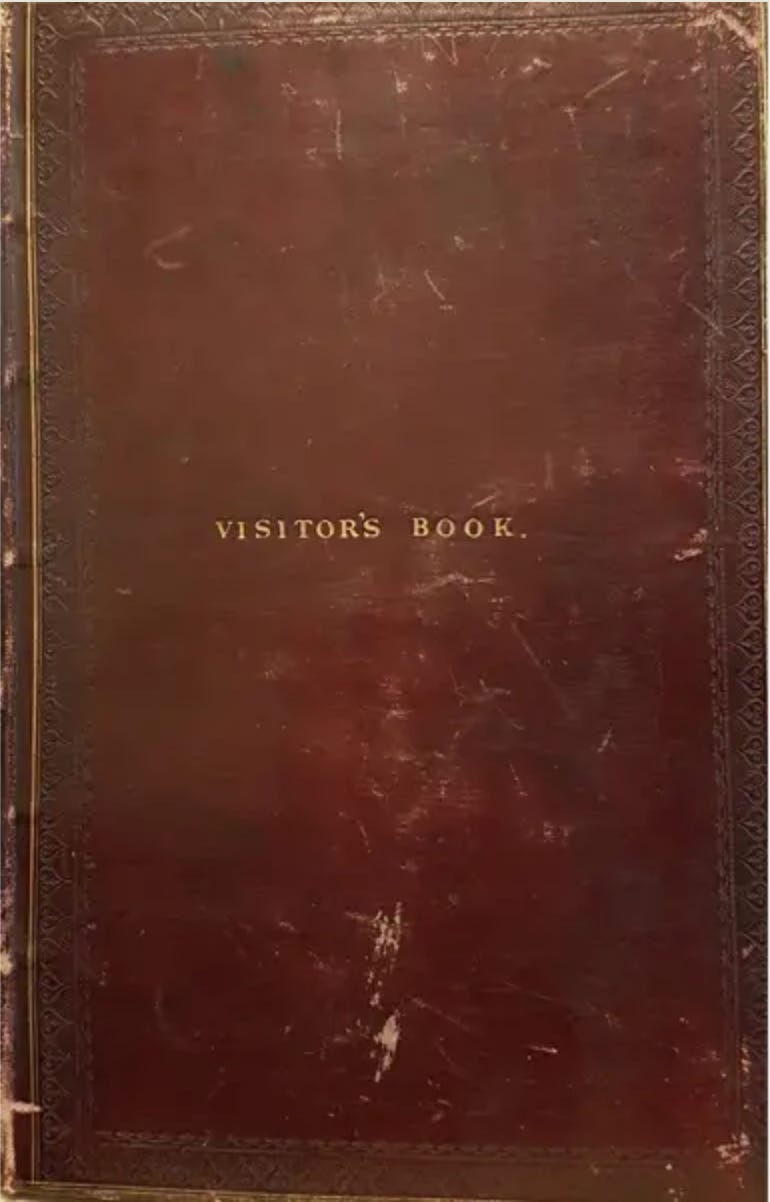
Happily, I - who had taken ages to try and work out the most ornate compliment (just polishing the final couplet) - came after this, and was able just to pop down my name and a truncated address.
I mean look at the VB from Chartwell, Winston Churchill’s old digs. NAMES, not even addresses. JUST NAMES. And one of them is the QUEEN.
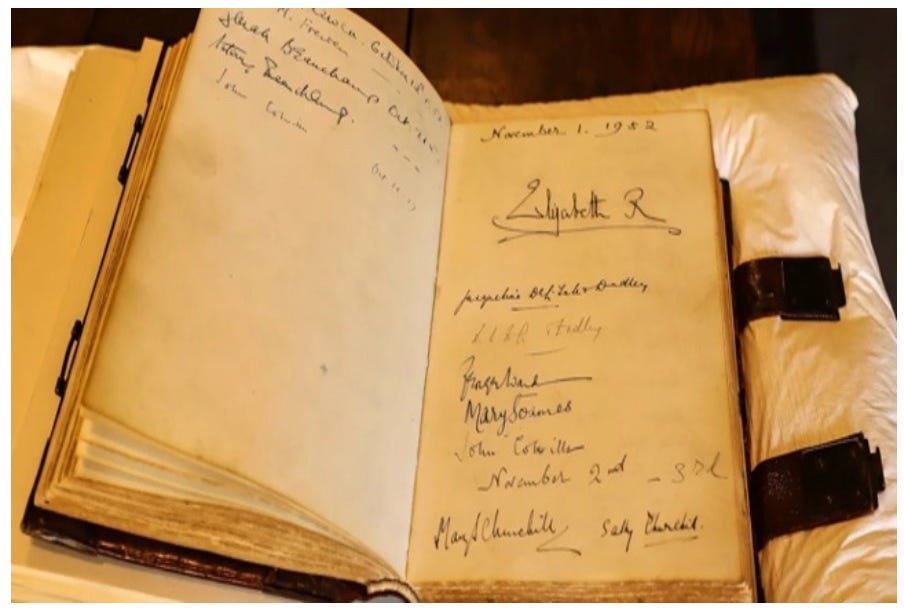
Why not have a look though
In fact, what with all the digitisation projects and such, you can now have a ramble through some old VBs and enjoy all the fun of doing it at someone’s house.
Here’s the one for Hertford House which became the Wallace Collection: HERTFORD HOUSE VISITORS BOOK
Here’s Belton’s one (thanks to the people at ‘The Untold History of Belton House’): BELTON'S VISITOR BOOK
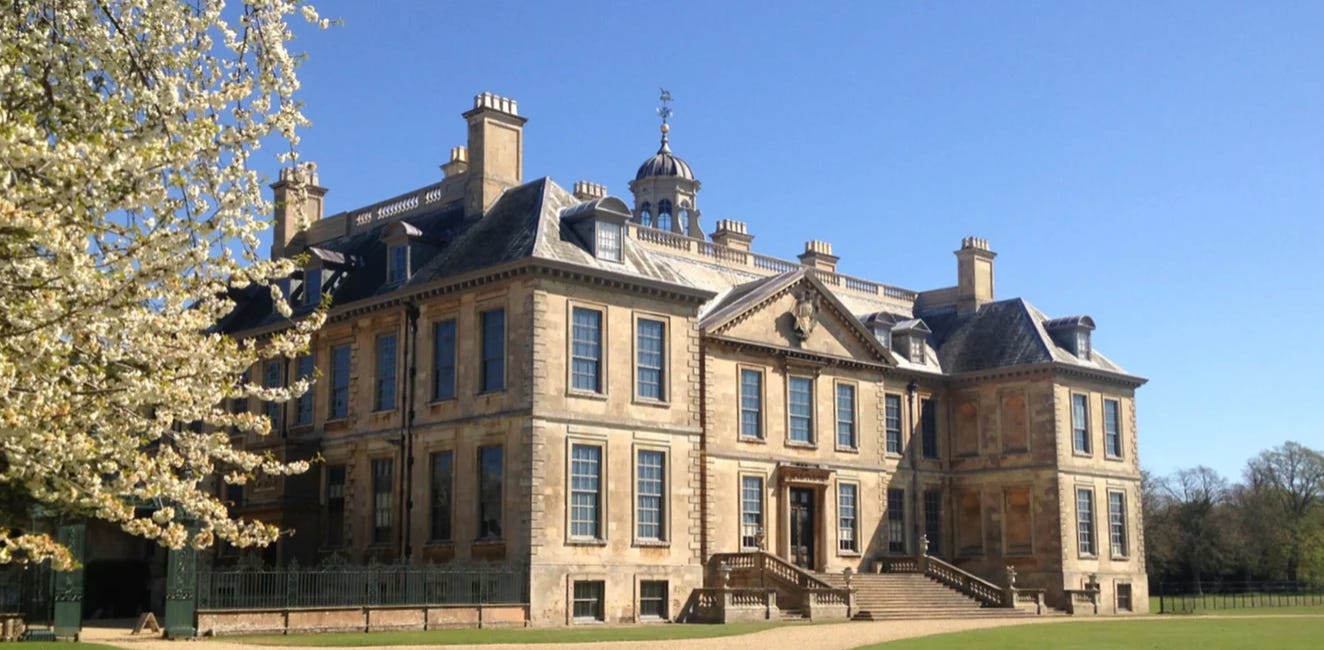
Sophia Money-Coutts, once of Tatler, wrote about them in 2015, and noted she can’t write comments because she was always told it was “vulgar”
What you are supposed to do, I have always been told, is write the date and your name AND NOTHING ELSE, just as seriously as if you were signing your will. Some people add part of their address, but never the whole thing because that suggests you might live on something as common as a street with lots of other people. Just 'London, SW6' would do, for example. Or preferably 'Blenheim' or 'Alnwick'.3
She then says, “oh let’s throw those old rules out” and let’s have fun. Well, much as I agree with S M-C on everything, here I am actually 1000% OPPOSED. [Though, as I’m sure everyone knows her peerless substack is a Top Recommend].

Mary Killen in the Spectator in January 2025 says that grandees often enforce the rule:
“lengthy descriptions and compliments are not encouraged by grandees who keep visitors books for friends. They want only name and date. In fact they often enforce this by standing next to those signing. The reason for this diktat is that so many people get into a state trying to think of something witty or appropriate to say.”4
C.A.M.M.K. (i.e., ‘couldn’t agree more Mary Killen’). For it is a Rule With a Purpose.
Unlike a thank you note (on which I am hopeful several posts will come) - the bloody thank you in the VB is written in haste, when you’re a bit hungover and full, probably after a big lunch (if you’re lucky), probably in a terrible rush for your train, in a tizz about tipping (another post for another day), spiralling about something stupid you said over dinner the night before, worried about having left some pants somewhere, and then you’ve suddenly got to be Oscar bloody Wilde … and it’ll be there FOREVER for EVERYONE TO READ FOREVER.
Probably one day to be digitised. Or sold, like this one here.
No no thanks - just pop down the name and scarper. (Then start worrying about your thank you note …)
He did, alas, die in 1989
Wasn’t it always thus? When you didn’t know how to start a piece of written work, you could always rely on cracking open the old dictionary (“c.1480 - a book that explains or translates, normally in alphabetical order, the words of a language or languages”) and diligently copying out the definition in order to cram a few extra words into ones essay. Of course, I am just joking - this is not padding - it’s GENUINELY important for the thesis.
‘The New Visitors’ Book Etiquette”, Tatler, 18th March 2015, https://www.tatler.com/article/the-new-visitors-book-etiquette
‘The unwritten rules of visitors books’, the Spectator https://www.spectator.co.uk/article/the-unwritten-rules-of-visitors-books/
Your newsletter is such a breath of fresh air!! Always love having it in the inbox. I love visitor’s books, and my grandparents have one at their summer house and DO enforce leaving comments, descriptions, and drawings!